The Real-Life Dracula Shed Tears of Blood

Vlad the Impaler
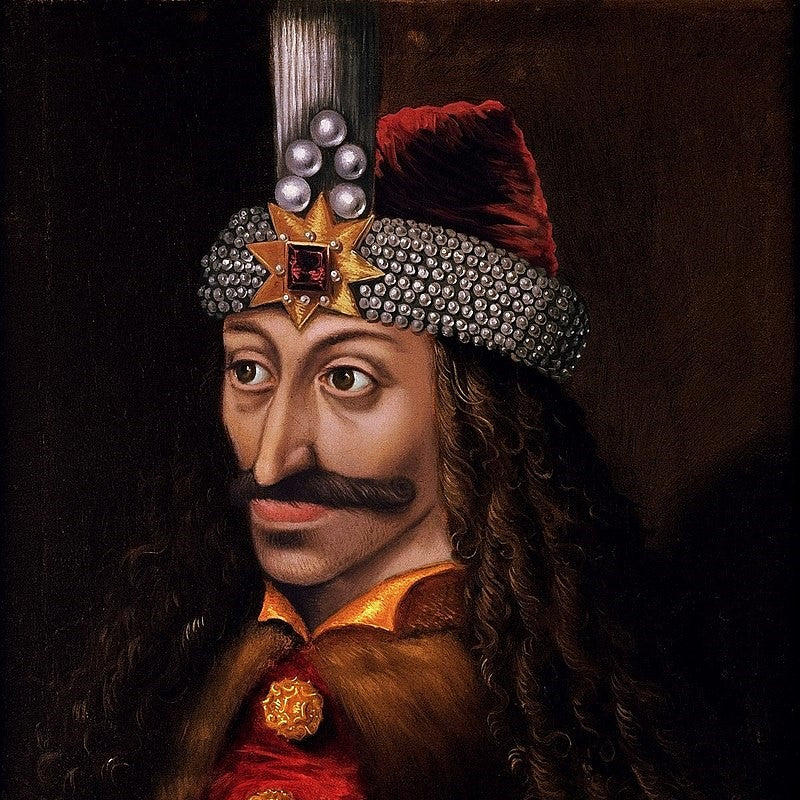
In searching for inspiration for his vampire count, Bram Stoker selected Vlad III, the 15th-century ruler of Wallachia. How much Stoker knew about the real-life Dracula is still debated, but Vlad III was a brutal villain in his own right, once impaling an army of 20,000 invading Ottomans. Just recently, another bloody detail surrounding the voivode of Wallachia has been lent credence, that Vlad the Impaler shed tears of blood, a condition called hemolacria. Vlad III may not have been a vampire, but barbaric war tactics and an unusual blood condition may have helped paint a picture of a real-world monster.
The study in question examined three letters written by Vlad III in 1457 and 1475 for biological material left behind by the prince. A thin film of Ethylene-vinyl acetate aligned with positive and negative ions and hydrophobic resin extracted proteins on the papers which were then subject to a mass spectrometry examination. The study identified roughly 100 human peptides (a sub-unit of proteins) along with 2,000 environmental peptides (plants, insects, bacteria). 31 of the human peptides are found in human blood while another three are linked to tear production. This suggests that tears may have deposited the blood material on the letters.

One of the letters under mass spectrometric analysis
The presence of the 2,000 other peptides also tells scientists something about the environmental conditions in which the letters were written. Wallachia in the 15th century was ravaged by disease, and Vlad III’s letters are a testament to this. 22 proteins identified as viruses include the Flaviviridae family, a group that is spread by mosquitos and ticks and can cause yellow fever and dengue fever. The content of Vlad III’s letters themselves is fairly dry, having to do with taxation on the city of Sibiu, but on the pages is evidence of the instability of Vlad III’s kingdom.
As exciting as this find is, it comes with the obvious qualifier that other people handled these letters and it may have been them who were afflicted with hemolacria. Still, it stands to reason that Vlad III’s DNA would be the oldest material on the paper, as he was the one who wrote the letters, and it was these proteins that were specifically targeted. This find helps form a more complete picture of Vlad III, a historical figure from an unstable period of history that has long been shrouded in mystery. Vlad III’s reputation for barbarism is mostly the result of propaganda leaflets from his lifetime, but some of those unsavory details seem as though they were genuine, including his tears of blood.
Want to learn more about Vlad III or even get ahold of some Dracula artifacts? Check out this article about the prince.


Featured Product
Joe Frazier Boxing Glove
Latest News
-
 Nov 01, 2025 Is “Paul is Dead” Dead?: Unpacking One Of Pop Culture’s Most Enduring Conspiracy Theories Read More
 -
 Oct 31, 2025 Scientists Discover Hooves and Skin in Preserved Dinosaur "Mummies!" Read More
 -
 Oct 27, 2025 Scientists Record a Bat Catching Birds Mid-Flight! Read More
 -
 Oct 09, 2025 Scientists Discover First Fossilized Leech! Read More
 -
 Oct 01, 2025 Researchers Recreate Dinosaur Sounds Using Bizarre Instrument! Read More
 -
 Sep 19, 2025 The House that Ruth Built: The Story of the Old Yankee Stadium Read More
Cool Things!


Is “Paul is Dead” Dead?: Unpacking One Of Pop Culture’s Most Enduring Conspiracy Theories


Scientists Discover Hooves and Skin in Preserved Dinosaur "Mummies!"
A dinosaur discovery just in time for Halloween! In a new analysis of a group of fossils from Wyoming, Scientists have determined this group of fossils are dinosaur “mummies,” with preserved skin and even hooves.


Scientists Record a Bat Catching Birds Mid-Flight!
Bats, birds, screeches, oh my! In a reverse-Hitchcock twist, a new study reveals that a species of European bat catches and eats birds mid-flight.
Specimen Deep Dives


The House that Ruth Built: The Story of the Old Yankee Stadium


The Queen of the Skies: the Story of the Boeing 747


Old Ironsides: The USS Constitution and the Start of the U.S. Navy
Long Form Articles


The Artist Behind the Macintosh: Susan Kare and Apple Computers
While the two Steves, Jobs and Wozniak, are the most well known faces behind Apple computers, equally important to the products and culture of the company were those who crafted the experience of using their computers through design. The most notable of these visual architects was Susan Kare, a designer responsible for “humanizing” Macintosh computers.


Can I Lick It? Yes You Can!
Have you ever been unable to tell if a fossil was really a fossil, but you were too embarrassed to admit it? Have you ever wanted to lick a fossil just because, but you didn’t want to risk judgment from your peers? Well, good news! You can kill two birds with one stone! Licking a fossil can actually help you determine if it’s the real deal or just another rock.


Is It Legal To Own a Meteorite: How to Start Your Outer Space Collection!
Meteorites are some of the rarest geological specimens to be found on Earth. Of course, since these stones are not of our world, purchasing them can sometimes be a confusing process. Is it legal to own a meteorite? In short, yes! Read on for help starting your cosmic collection!