Antarctic Palm


Antarctic Palm
Antarctica was not always the frozen wasteland we see today. 55 million years ago, the continent was a lush forest filled with plants that can still be found below the Antarctic ice in fossil form.
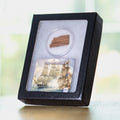
This specimen is a fossil palm tree fragment, uncovered during a Soviet expedition to the continent in 1986. It measures between 0.5-0.75" and ships in a handsome riker display case with an informational card that serves as statement of authenticity.


HIT THE BEACH!
Across the billions of years of Earth's history, our continents have ceaselessly migrated, propelled by the shifting tectonic forces below the surface. These movements mean that different continents have looked vastly different in their ancients pasts, including Antarctica, which was once a lush forest of conifer trees and other plants.
Beneath the ice of Antarctica, traces of this tropical past can be found: fossilized plants that reveal the environment the South Pole once hosted.


This specimen is a fossil fragment that was gathered from the coal-bearing band in Mac. Robertson Land by one of the last Soviet research expeditions in 1986. It is estimated to be around 55,000,000 years old.
While heading back to the mainland on a boat, the research team threw several redundant and unnecessary specimens overboard. This was salvaged from that purge.
The specimen ships in an acrylic gem jar along with a glass-topped display case and an informational photo card which serves as statement of authenticity.


📸 ANTARCTICA TODAY, WITH A VIEW OF MOUNT HERSCHEL
MORE ANTARCTIC PALM


📸 GONDWANA 420 MILLION YEARS AGO
THE LUSH ANTARCTIC
Chilling landscapes of ice and snow are probably what comes to mind when you think of Antarctica, but this wasn’t always what Earth’s southernmost continent looked like. While it is frozen over today, there was a time when Antarctica was a swampy land full of forests and animals living their lives near the bottom of the globe.
Antarctica was originally part of the supercontinent Gondwana and the landmass centered around the South Pole in the Paleozoic about 360 million years ago, though it looked nothing like how it does today. Earth’s carbon dioxide levels were roughly two and a half times higher than they are today, and, instead of ice, thick forests of beech trees and conifers dominated the interior of the continent, while coastal areas were lined with palm trees. Evidence of many different plants, synapsids, trilobites, and even dinosaurs have been found to have lived in Antarctica through the ages, painting a picture of a subtropical environment.


📸 THE ANTARCTIC CIRCUMPOLAR CURRENT TODAY
During the early Eocene Epoch, a land bridge existed between Antarctica and Australia. By the midpoint of the epoch, shifting continental plates opened a gap between Australia and Antarctica, allowing water to rush in. This deep-water channel created a boundary current around Antarctica, which we now call the Antarctic Circumpolar Current.
This current kept warm ocean waters from reaching the newly isolated Antarctica and caused its temperature to fall. Ice and glaciers formed over the land and in the waters around it and the only remains of its former ecosystem were fossils and coals in the mountainous regions. Today, the Antarctic Circumpolar Current is responsible for keeping Antarctica in a permanent deep freeze. It is also one of the most important ocean currents, connecting the Indian, Pacific, and Atlantic Oceans and allowing these waters to exchange nutrients and energy.
Further Reading
Becquey, Sabine, and Rainer Gersonde. “A 0.55–Ma paleotemperature record from the Subantarctic zone: Implications for Antarctic Circumpolar Current development.” Paleoceanography 18.1 (2003).
Holbourn, Ann, et al. “Impacts of orbital forcing and atmospheric carbon dioxide on Miocene ice-sheet expansion.” Nature 438.7067 (2005): 483-487.


Gold Baltic Amber Necklace - G


Baltic Amber Necklace - Silver Setting - P