Plesiosaur Paddle Fossil


Plesiosaur Paddle Fossil
Featuring a long, snake-like neck and a stout body equipped with slender paddles, Plesiosaurs are one of the most readily identifiable of all ancient marine reptiles.
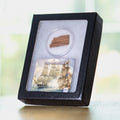
This specimen is a 0.75-1" fragment of a fossilized Plesiosaur paddle, used to propel the sea creature at high speed through the ocean. Our paddle specimens come from fragments of several Plesiosaurs, recovered on private land in the Lower Oxford Clay of Cambridgeshire and the Coast of Dorset in England. Some material also comes from the Morrison Formation in Utah. They date back over 150,000,000 years to the Jurassic Period.
The fossil comes in a glass-topped display case, complete with an informational card that serves as certificate of authenticity.


Featuring a long, snake-like neck and a stout body equipped with slender paddles, Plesiosaurs are one of the most readily identifiable of all ancient marine reptiles.
Biomechanical reconstructions suggest that Plesiosaurs moved through the water in the same way that turtles or penguins do, more like flying than swimming. Scientists have also discovered that Plesiosaurs used their unique bodies to hunt for bottom-dwelling crustaceans.


This specimen is a piece of fossilized Plesiosaur paddle source from fragments (humerus, femur, and podials) of several Plesiosaurs. They were recovered on private land in the Lower Oxford Clay of Cambridgeshire and the Coast of Dorset in England. Some material also comes from the Morrison Formation of Utah. These formations all date back over 150,000,000 years to the Jurassic Period.
All specimens are enclosed in an acrylic specimen jar with a removable top which arrives in a handsome, glass-topped riker box case measuring 4x3x1". It comes complete with an informational card that serves as statement of authenticity.
Check out our showcase Plesiosaur fossil teeth below!


TEMPORAL RANGE: 203,600,000-66,000,000 years ago
MORE ABOUT PLESIOSAURS
"Like a sea serpent run through a turtle." ~ William Buckland, Oxford University Geology Lectures, 1832


With nearly 140 million years in the fossil record, Plesiosaurs were incredibly successful creatures. As air-breathing reptiles, they lived near the surface in the open seas, and were able to spread around the world. Fossilized skeletons of Plesiosaurs have been found in Europe, North America, and Australia.
New paleontological evidence suggests that Plesiosaurs may have given birth to live young instead of laying eggs, adding an interesting twist to a very unique family of reptiles.

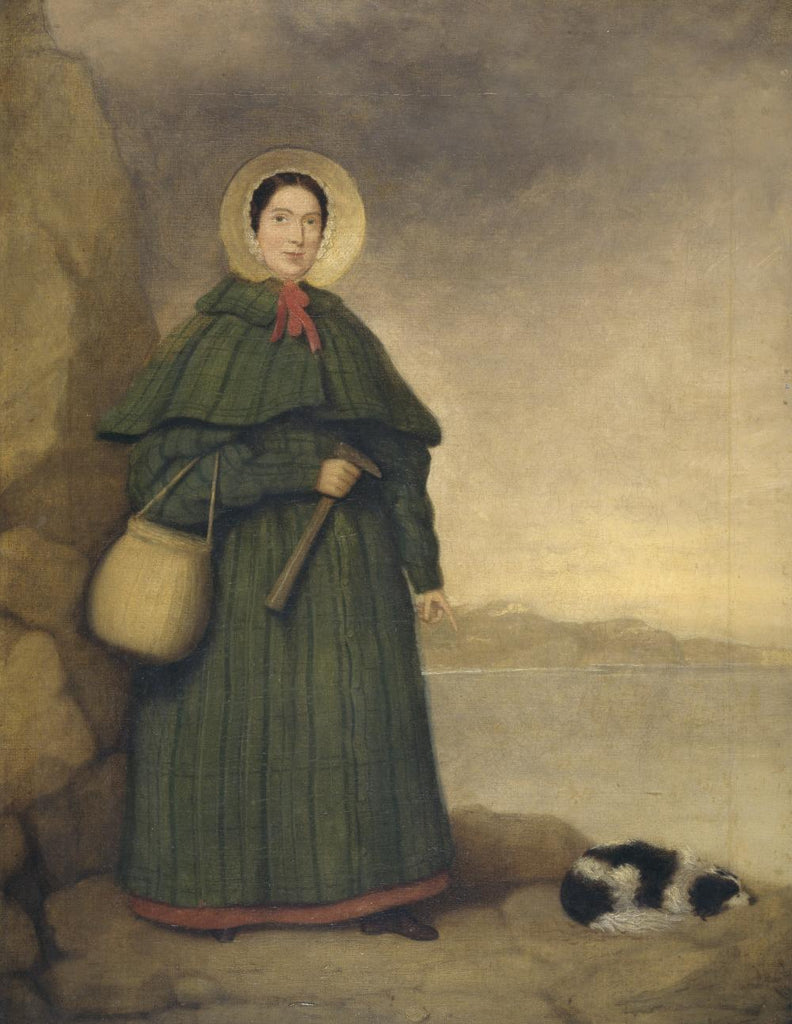
📸 Portrait of Anning (before 1842)
MARY ANNING (1799-1847)
The story of marine reptiles such as the Plesiosaur, not to mention our modern understanding of species extinction, would be incomplete without discussing the contribution of Mary Anning (1799-1847).
Ms. Anning was born to a working-class family in Lyme Regis, a small town on the Dorset coast of southern England. Like many in the area, Anning's family sold fossils recovered from the cliffs, but for Mary, it would become a primary source of revenue, and later a connection to the much wider world of science.
Her most notable finds include the first complete Ichthyosaurus and the first two complete Plesiosaurs (the first of which is also credited to her brother Joseph). She is also credited with being the first to recognize the importance of coprolites and had extensive knowledge of ammonites.


📸 Plesiosaur sketch by anning
Yet, despite her firsthand experience and deep knowledge of these subjects, Ms. Anning was unable to take part officially in the scientific societies of the day which were only open to men. Her discoveries and observations were instead shared through others, with the one notable exception being her drawing of a complete Plesiosaur. In this instance, the noted French anatomist Georges Cuvier proclaimed the animal a hoax. It would take numerous examinations and debate before Cuvier would reverse his position and admit he'd rushed to judgement.
Ms. Anning died in 1847 of breast cancer. It would take another 163 years for the Royal Society to recognize her influence in the advancement of science.
Further Reading
Emling, Shelley. The fossil hunter: dinosaurs, evolution, and the woman whose discoveries changed the world. St. Martin's Press, 2009.
Briggs, Helen. "The story of 'Eve' the Jurassic sea monster." BBC News. British Broadcasting News, 29 May 2016. Web. 7 March 2018.
Liu, Shiqiu; Adam S. Smith, Yuting Gu, Jie Tan, C. Karen Liu, and Greg Turk. "Computer Simulations Imply Forelimb-Dominated Underwater Flight in Plesiosaurs." PLoS Computational Biology 11.12 (2015):1-18. EBSCOhost. Web. 7 March 2018.
Nicholls, Elizabeth L., and Jack M. Callaway. Ancient Marine Reptiles. San Diego: Academic Press. 1997. EBSCOhost. Web. 7 March 2018.
Knutsen, E.M., P.S. Druckenmiller, and J.H. Hurum. "Two new species of long-necked plesiosaurians (Reptilia: Sauropterygia) from the Upper Jurassic (Middle Volgian) Agardhfjellet Formation of central Spitsbergen." Norwegian Journal of Geology, Vol 92, pp. 187-212. Trondheim 2012, ISSN 029- 196X.