Edmontosaurus Tooth


Edmontosaurus Tooth
Edmontosaurus was a large herbivorous dinosaur from the Cretaceous Period. A member of the hadrosaur family, they are known for their "duck-bills," which are in fact elongated rostral bone structures with the appearance of a beak. These "beaks" actually housed hundreds of small teeth that allowed these giant herbivores to grind through all manner of plant material, including rotten wood.
This specimen is a fossilized tooth from an Edmontosaurus, recovered on private land from the Hell Creek Formation. The specimen comes inside a classic, glass-topped riker display case measuring 4 1/2" x 3 1/2". A small information card with the Mini Museum statement of authenticity is also enclosed.
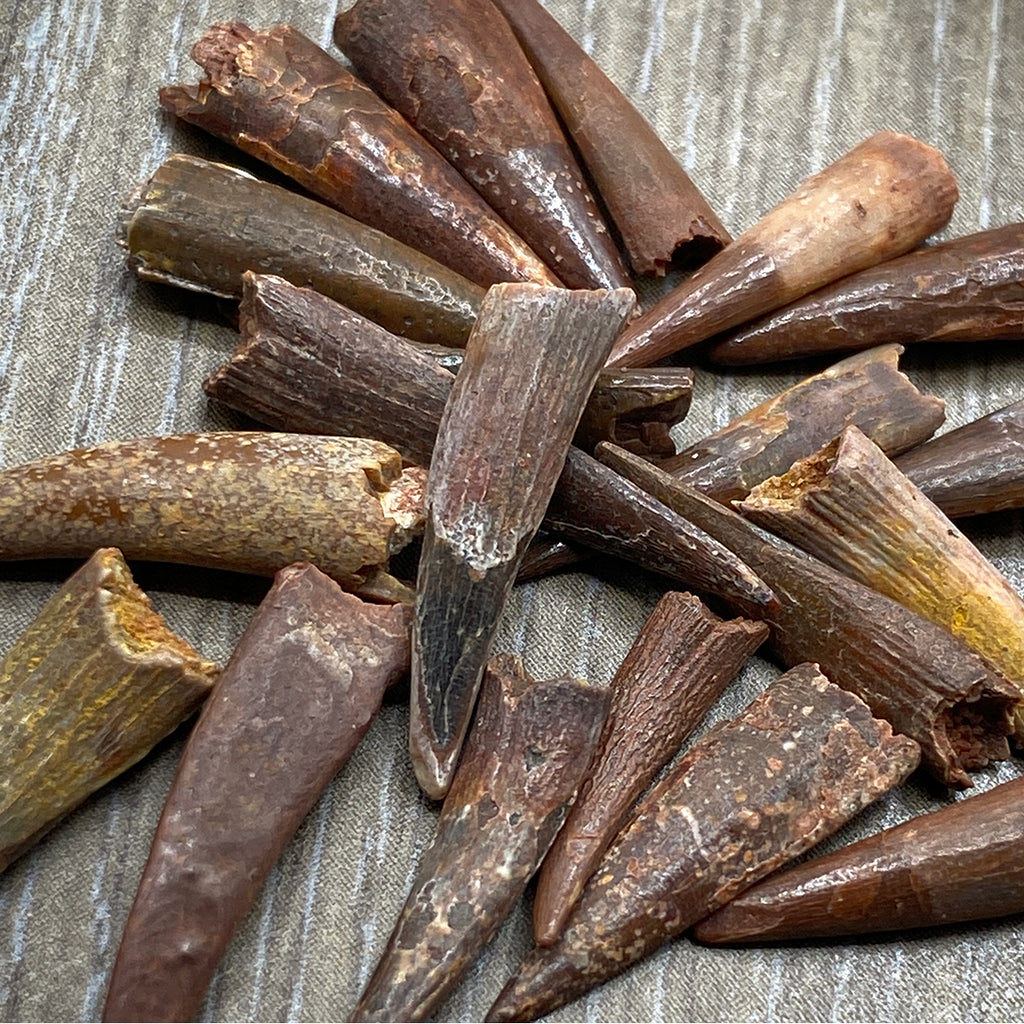
Each tooth is a unique fossil and measures between 0.25" to 0.5" in size. No two will be exactly alike.


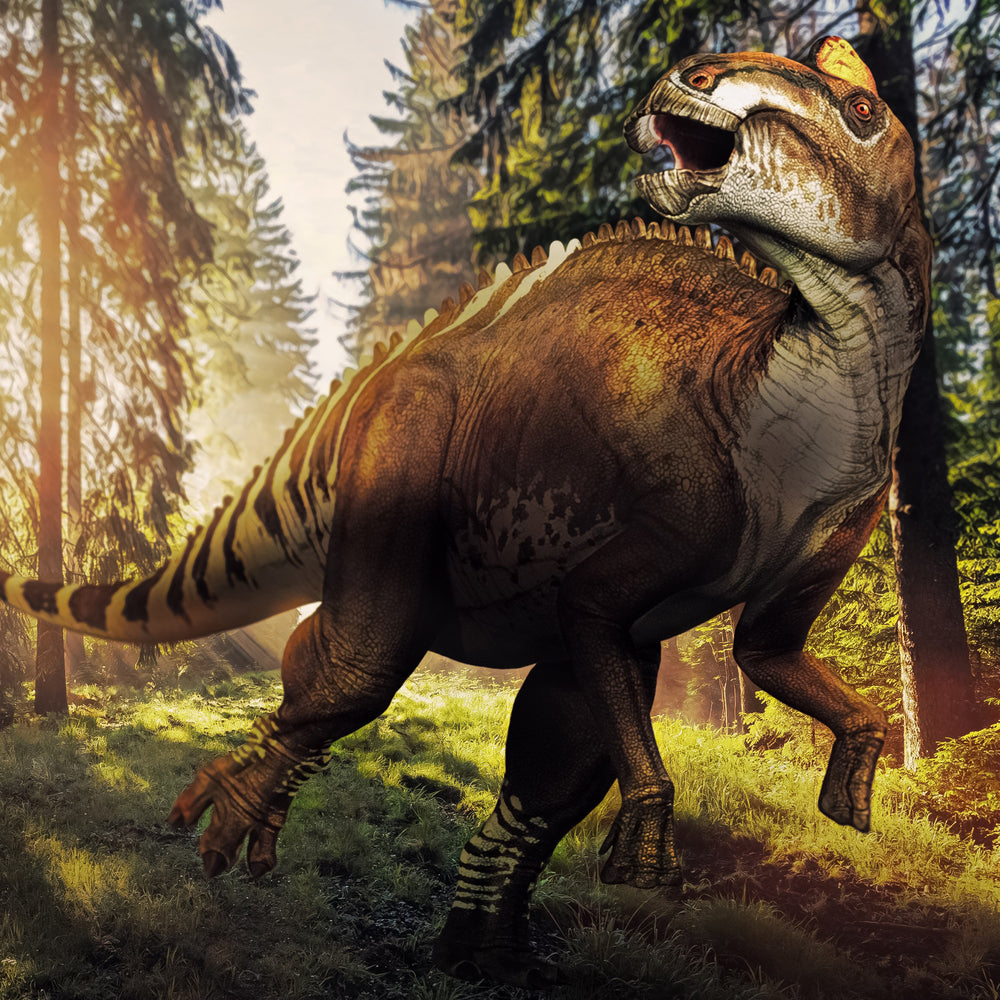
📸 An artist's depiction of the Edmontosaurus
The Duck-Billed Dinosaurs
With a beak-like skull structure to grind berries and twigs, Edmontosaurus was a very unique looking dinosaur. As a descendant of the Iguanodon, it had long and tough forefingers that appeared almost as hooves, letting it move quickly over the Cretaceous landscape.
Its teeth were stacked in a column formation, continually growing upwards to replace one another. This structure is known as a "dental battery," a useful adaptation for herbivores that were constantly grinding tough roots, leaves, and wood.
Edmontosaurus belonged to the larger group of dinosaurs called Hadrosaurs. These herbivores were an important part of the Mesozoic ecosystem and fossils of Edmontosaurus can be found across North America.
📸 Sample Edmontosaurus Teeth
This specimen is a fossilized tooth belonging to Edmontosaurus that was recovered from private land in the Hell Creek Formation. This Cretaceous Period site is over 65 million years old.
Each of these fossils is a unique piece of a prehistoric dinosaur. They are shipped in a glass-topped display case along with a statement of authenticity. Each is a unique and high quality fossil, perfect for any paleontologist's collection!
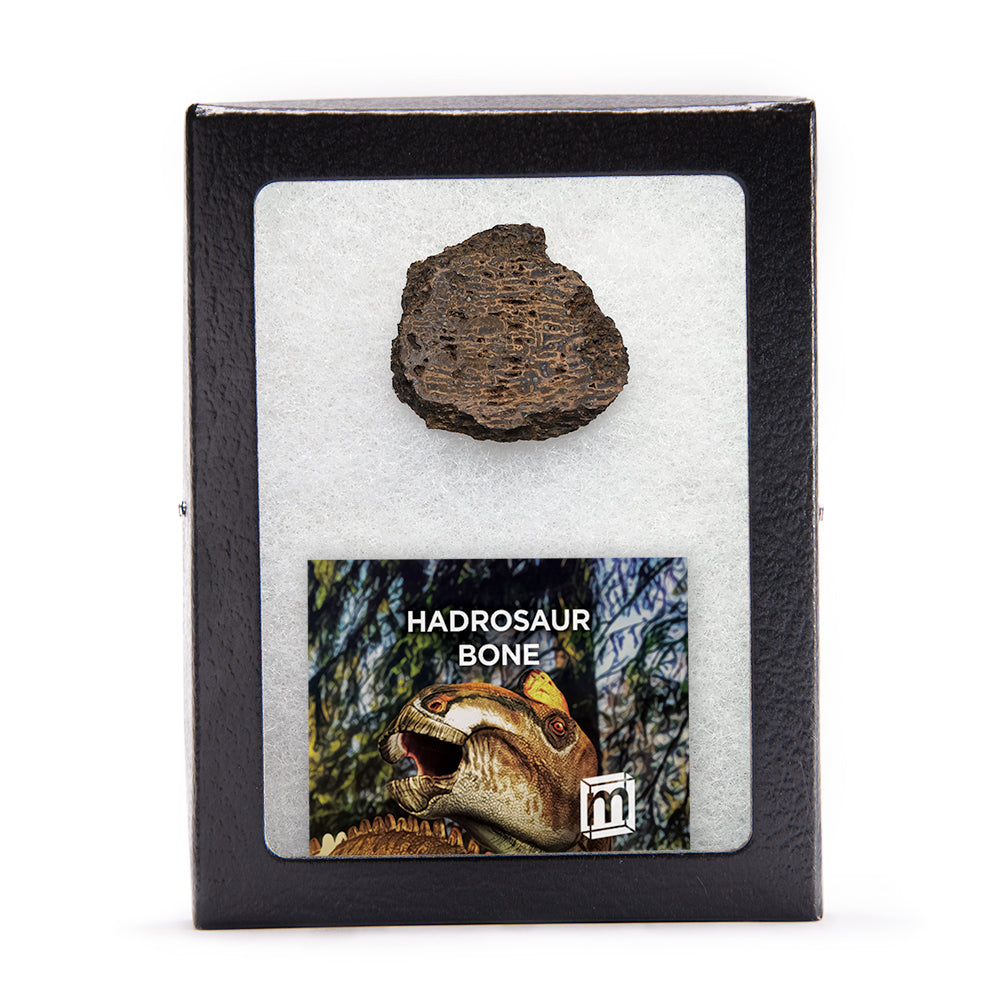
Several Edmontosaurus and other Hadrosaur fossils are available in the shop and are sold separately by size. You can see them all at the collection below. We have a smaller display case sized specimen of Hadrosaur bone from an Edmontosaurus available as well.




MORE ABOUT Edmontosaurus and Hadrosaurs
"Hadrosaurs grew rapidly, and quantifying their growth is key to understanding life-history interactions between predators and prey during the Late Cretaceous." ~ Lisa Noelle Cooper, "Relative growth rates of predator and prey dinosaurs reflect effects of predation."


📸 Hadrosaur Evolutionary PAths
The Dinosaur Family Tree
Evolution is inherently fractal, primed to spawn off divergent species specifically adapted to their own environments. Among dinosaurs, there are at least one thousand distinct species, each molded by their surroundings to be best suited for their own survival.
For example, consider Hadrosauridae. Hadrosauridae was a large family of Ornithischian dinosaurs from the Cretaceous Period. They had a global distribution and there is significant evidence of migratory behavior in many species, with exception of those at the poles which typically remained in place year round.


📸 Incomplete cranium of Edmontosaurus regalis, dorsal and lateral views - Xing, Mallon, Currie (2017)
Amongst the vast umbrella of Hadrosauridea are dozens of branching species that maintain certain basic characteristics. Descendants of the Iguanodons, Hadrosaurs did not have the specialized first digit on their forelimbs. The three middle fingers were all tipped with hooves, for support, resulting in a largely quadruped animal.
The Hadrosaurs are known primarily for their "duck-bills." This beak-like structure was in fact an elongated rostral bone housing hundreds of small teeth, that allowed these giant herbivores to grind through all manner of plant material, including twigs, berries, coarse plant matter, and even rotten wood.
While certain characteristics appear in every hadrosauridae species, there are important divergences where evolution fractures off into different species. For example, consider the two dueling species of the Edmontosaurus genus.


The Edmontosaurus Branch
Edmontosaurus regalis and Edmontosaurus annectens: At first glance, there seems to be little distinction between them beyond their names, but upon closer inspection the two species diverge from one another in important ways.
E. Regalis appears in the fossil record earlier than its cousin E. Annectens, dating from the Campanian stage of the Cretaceous period, while E. Annectens only appears in the Maastrichtian. Regalis was the bigger of the two species, with a more pronounced skull shape.
A difference in skull shape may seem like a trivial distinction at first, but it draws a clear line between the species. A larger skull allows for a larger cranium, thus the potential for greater intelligence and remarkably different behavior between the two species.


📸 Othneil Marsh (Back Center) and his band of assistants preparing for an 1872 expedition.
The Bone Wars
The study of Edmontosaurus’s species dovetails with one of paleontology’s strangest episodes, the Bone Wars. The original E. annectens uncovered was identified by paleontologist Edward Drinker Cope, though it was then know as Anatosaurus copei.
A few years later his fierce rival Othniel Charles Marsh identified another annectens as Trachodon longiceps. This was only one of many competitions between the pair, who’s conflict saw both the discovery of many fossils and destruction of each other’s specimen in their attempts to ruin each other.
Nothing was off the table for these two men — sabotage, libel, threats, and perhaps even the use of dynamite to scare rivals off were reported. In the end, both men were left financially ruined, but through their exploits over 130 new species of dinosaurs had been discovered.
Further Reading
DONALD R. PROTHERO. “APATOSAURUS AND BRONTOSAURUS: MARSH, COPE, AND THE BONE WARS.” The Story of the Dinosaurs in 25 Discoveries. Columbia University Press, 2019. 95–. Web.
Eberth, David A., David C. Evans, and Patricia E. Ralrick. Hadrosaurs. Ed. David A. Eberth and David C. (David Christopher) Evans. Bloomington: Indiana University Press, 2015. Print.
Norell, Mark. The World of Dinosaurs: An Illustrated Tour. Chicago: The University of Chicago Press, 2019. Web. (pg. 212-
Vanderven, Evan, Michael E Burns, and Philip J Currie. “Histologic Growth Dynamic Study of Edmontosaurus Regalis (Dinosauria, Hadrosauridae) from a Bonebed Assemblage of the Upper Cretaceous Horseshoe Canyon Formation, Edmonton, Alberta, Canada.” Canadian Journal of Earth Sciences 51.11 (2014): 1023–1033. Web.
Xing, Hai, Jordan C Mallon, and Margaret L Currie. “Supplementary Cranial Description of the Types of Edmontosaurus Regalis (Ornithischia: Hadrosauridae), with Comments on the Phylogenetics and Biogeography of Hadrosaurinae.” PloS one 12.4 (2017): e0175253–e0175253. Web.